The Return To Life
Meditation For People Who Can't Meditate
Nine years on the night rota taught Nadia Dulese how to stay switched on. Nothing taught her how to switch off — until something that hurt did it in ten minutes.
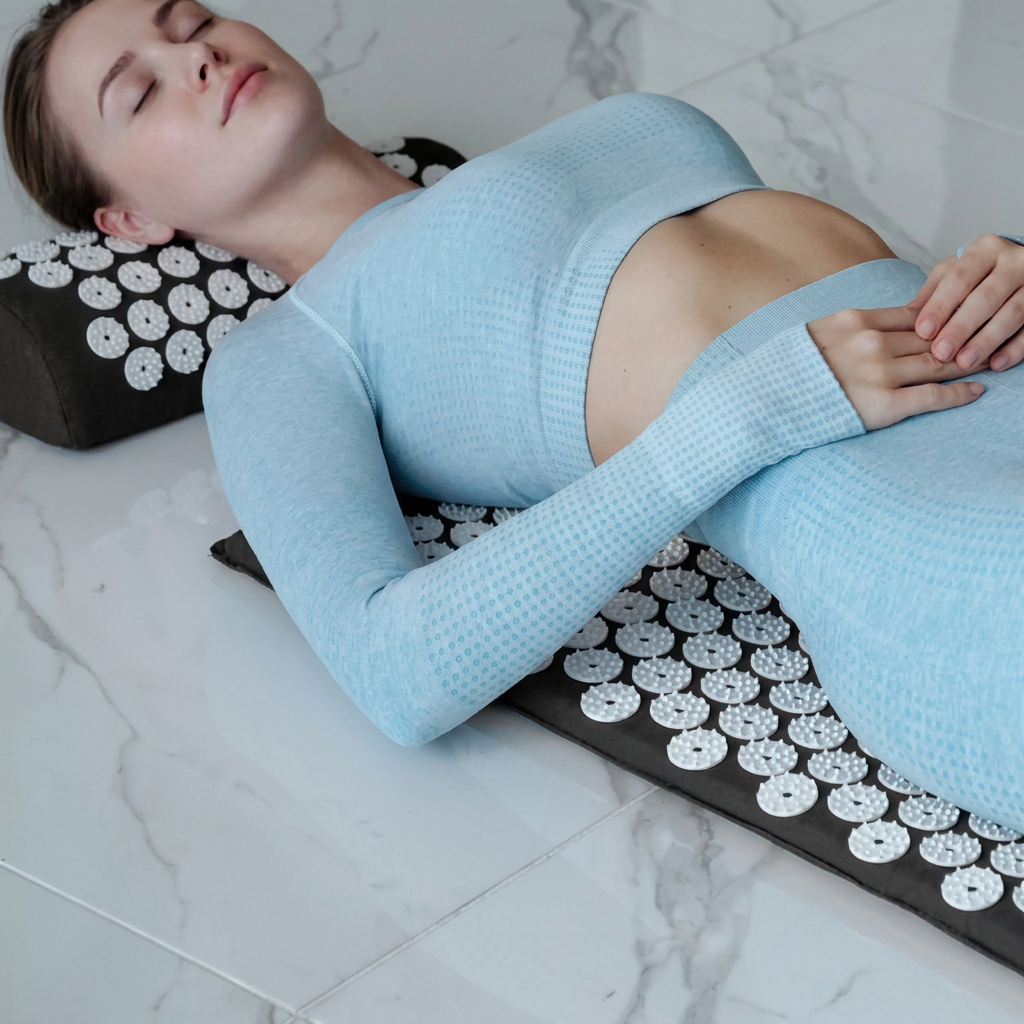
At 3:40 in the morning I could put a cannula in a shaking arm on the first try. At 8:15, sitting on the edge of my own bed with the curtains taped shut, I could not put myself to sleep to save my life.
Nine years of nights does something specific to you. It isn't tiredness — I was extremely good at tired. It was that my body had learned there was no such thing as an off shift. Some part of me stayed braced for the buzzer even in a dark room at nine in the morning, and it did not care how many hours I had been awake. I would lie there with my heart going and my legs restless, doing bed handovers in my head.
I want to be careful here, because I am not going to tell you a spiked plastic mat fixed nine years of nights. It didn't. What it did was give me an unambiguous physical signal that the shift was over — and that turned out to be the thing I had been missing for nine years.
The Problem Was Never That I Was Tired
Everyone I work with has a version of it. The paramedic who watches three hours of car reviews before he can close his eyes. The registrar who does her online shop at 4am. Two of the ward sisters who drink a large glass of something the second they get in, not because they enjoy it at 8am but because it is the fastest available way to feel a gear change.
That is what we are all actually buying: a gear change. A line on the floor with work on one side of it and the rest of your life on the other. If you commute, you get one for free — forty minutes of nothing where your body downshifts without you having to organise it. Shift workers lose that line completely, and so, it turns out, does everyone who deleted their commute in 2020 and never got it back.
Without the line, you don't stop. You just carry the shift into the room with you and then wonder why the sleep app says your resting heart rate is 98.
And it compounds in a way nobody warns you about. A bad handover at seven becomes a bad morning, which becomes four hours of thin sleep, which becomes going back in already depleted and slightly less able to let the next thing go. By year six I had stopped describing myself as stressed. I described myself as a person who simply doesn't sleep well — as though it were a fixed trait, like being tall.
“I didn't need to be more relaxed. I needed something loud enough to tell my body the shift had ended.”
Everything I Tried First, And Why It Failed
-
Meditation apps. Three of them, one paid for a whole year. Lying still with my eyes closed while wired is not calming, it is an invitation to think about the patient in bed four. I would last five minutes and feel worse.
-
Wine. Worked in eleven minutes, but I woke up feeling rubbish pre-shift. Also it is a fairly bleak thing to build into a routine at 25 past eight in the morning post-nights.
-
Massage. Genuinely brilliant. Also $70 and a two-week wait, which makes it a treat, not a boundary. You cannot put a boundary in your diary once a fortnight.
-
Stretching. Fine for my hamstrings. Did nothing whatsoever to my head, because it never got loud enough to interrupt anything.
There was a fifth, which I'll admit to because it is the most common one: doing nothing, in front of a screen, for two hours. That is what most of us actually pick. It feels like rest and it is not rest — it is the same wired attention pointed at a smaller rectangle, and you get up from it in exactly the state you sat down in.
The pattern took me embarrassingly long to see. Everything on that list was trying to make me calm. None of it was trying to interrupt me. And you cannot get calm by asking nicely a nervous system that has spent twelve hours being paid to be alert.
The Mechanism
You Have Two Gears. Nobody Teaches You The Downshift.
A nurse learns this in first year and then completely fails to apply it to herself. Your autonomic nervous system runs in two modes, and it will only ever be in one of them at a time.
Gear one — sympathetic
Braced. Scanning. On.
Heart rate up, muscles held, attention outward. Useful for a crash call. Useless at bedtime, and it does not clock off just because you did.
Gear two — parasympathetic
Heavy. Warm. Off.
Breath drops, hands warm, the noise in your head goes quiet. This is where sleep, digestion and actual recovery live. You cannot decide your way into it.
The switch between them is not run by willpower. It is run by physical input — pressure, temperature, breath, sensation on the skin. That is the whole trick, and it is why a mat with several hundred hard plastic points on it does something that a guided audio track never could. It gives the body a signal too specific to argue with, and the body downshifts because that is what it does when it is flooded with sensation and nothing bad is happening.
Ten Minutes On The Spikes, Measured Against The Alternatives
I made this table for a colleague who thought I had lost it. It is the honest version — the mat is not better at everything.
| Method | Time | Cost per use | Did it Work |
|---|---|---|---|
| A proper massage | Time60 min + travel | Cost per use$70 | Did it WorkYes — but no time or money to do daily |
| A large glass of wine | Time11 min | Cost per use$3 | Did it WorkYes — then my sleep quality takes a massive hit |
| A meditation app | Time10–20 min | Cost per use$0.50 | Did it WorkRarely — apps ask the mind to fix the body |
| Ten minutes on the spikes | Time10 min | Cost per useCents, forever | Did it WorkYes — odd at first, then you don't want to get up |
Costs are Nadia's own, in the US, 2026. Per-use figures assume the kit is used five times a week for a year.
What Actually Happened, Night By Night
A friend from the respiratory ward gave me the Verantu set for my birthday, which I took as a comment on my personality. Here is the log, because I kept one out of scepticism.
-
Night01
It hurts. Not injury-hurts. Loud-hurts.
The first thirty seconds are genuinely unpleasant and I nearly got straight back up. Then it changes into heat, and the heat spreads, and somewhere around minute four I noticed I had stopped thinking about work — not because I was trying to, but because there was no room left.
-
Night04
The first time I fell asleep on the floor
Ten minutes became twenty because I went under on the mat in my scrubs with the blinds still open. I have never once done that with an app running. That was the night I stopped thinking of it as a gadget and started thinking of it as the end of the shift.
-
Night11
The spikes stopped being the point
By the second week my body had learned the sequence — shoes off, mat down, ten minutes — and started downshifting before I was even lying on it. That is the bit nobody tells you. The mat is training wheels for a habit your nervous system takes over on its own.
-
Night30
I stopped dreading the evening
It used to take me several hours to feel like I'd actually left work. Now there's a point in the evening where the day just ends, and I know roughly when it'll happen. It isn't dramatic. It's ten minutes and then I'm somewhere else. I didn't expect to keep it up this long.
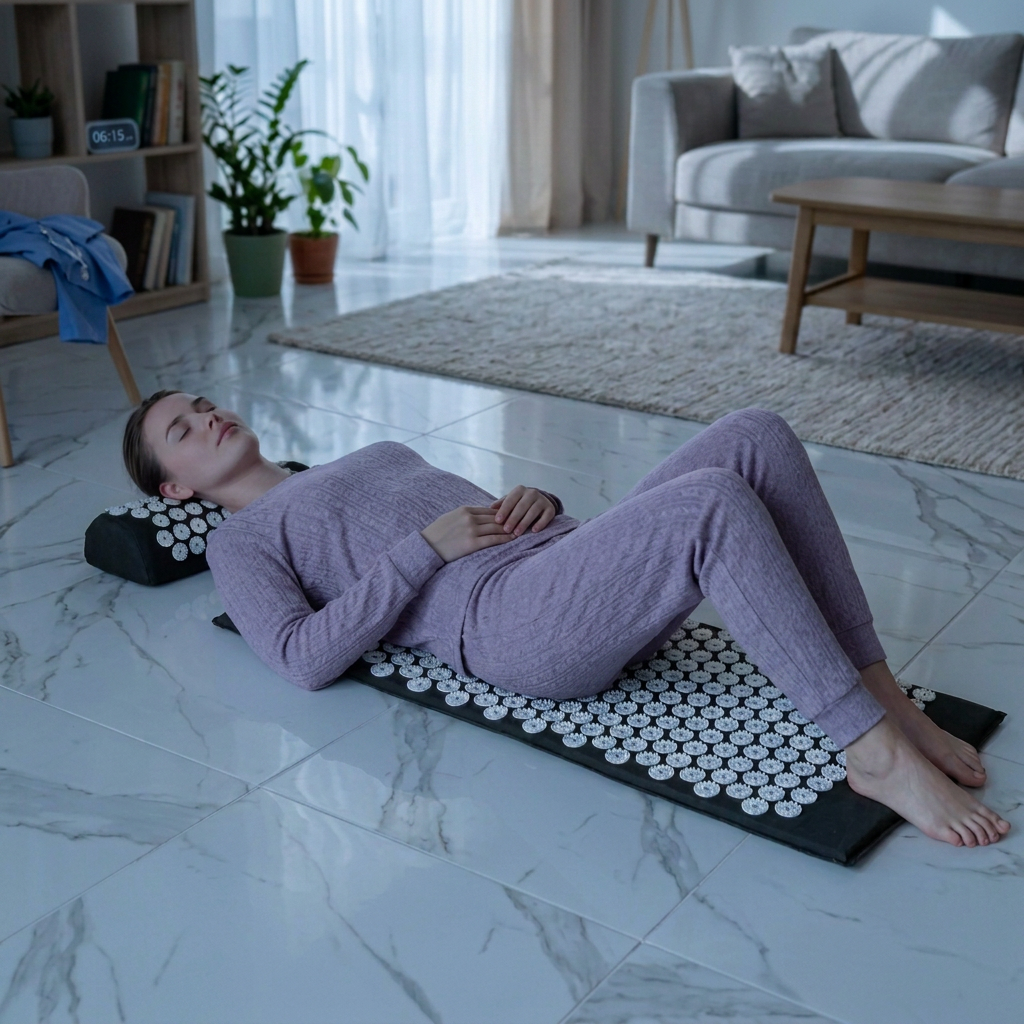
The Three Things I Actually Use
The set she gave me is Verantu's Whole Wind-Down Set. Three objects, no app, no subscription, no charging cable. I use two of them daily and the third twice a week.
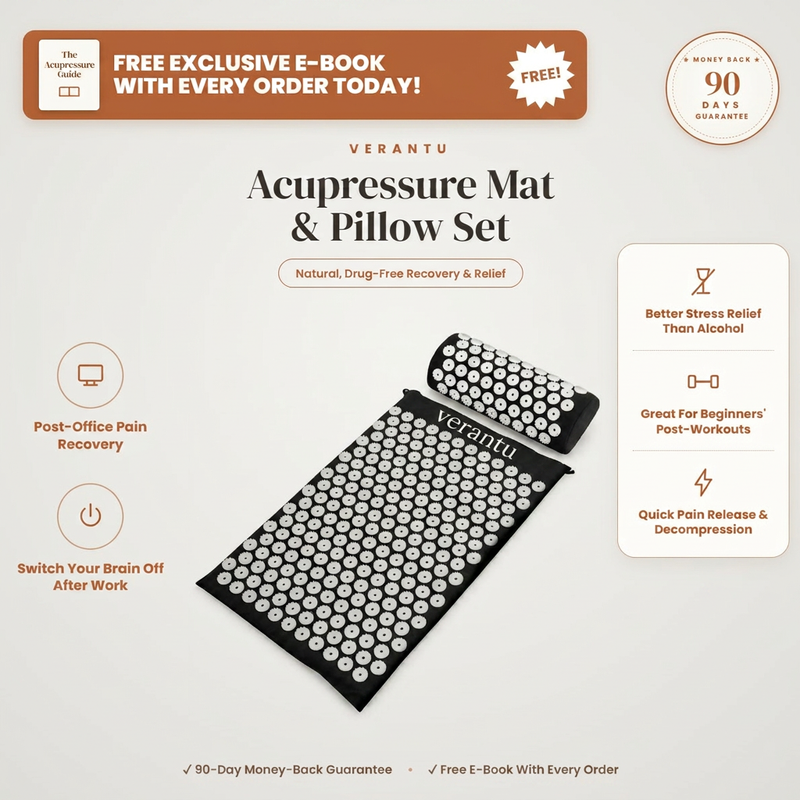
Mat & Pillow Set
Several hundred contact points across the back and neck. This is the one that ends the day; everything else is maintenance.
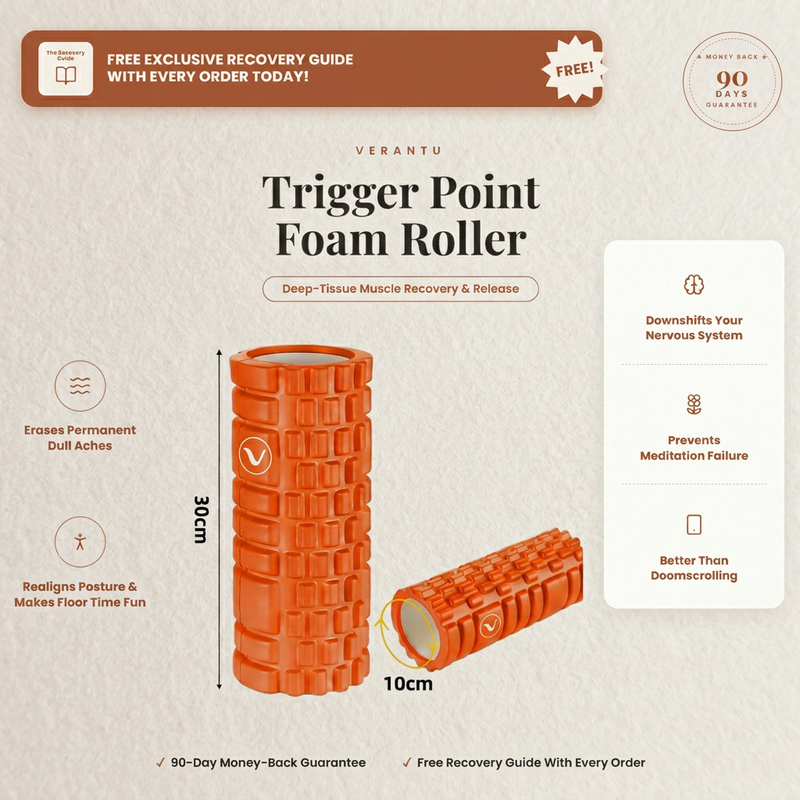
Textured Roller
For the days that were twelve hours on your feet. Slower than stretching, and you feel where you have been holding on.
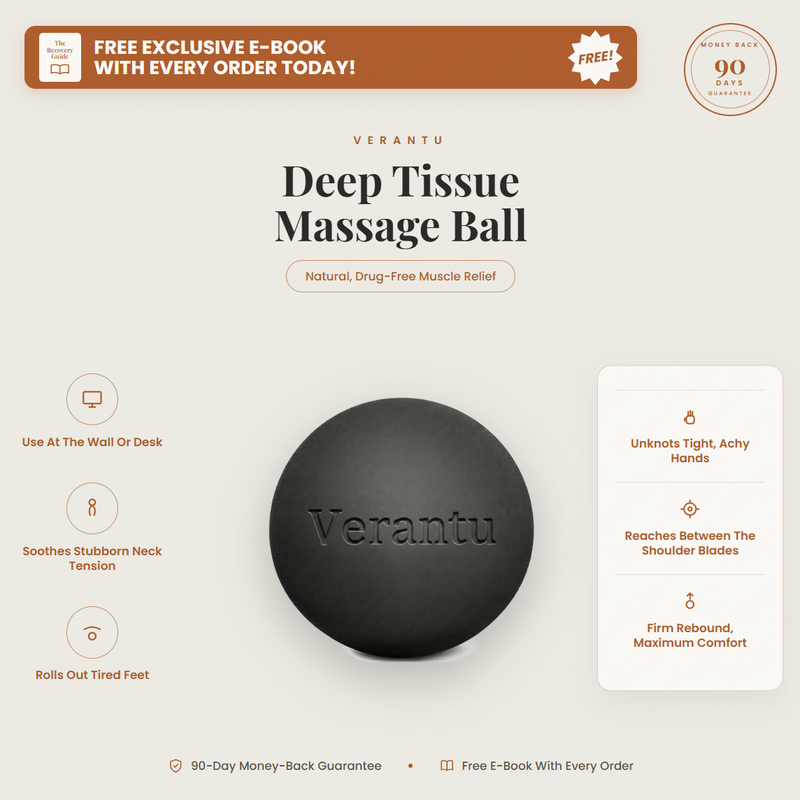
Massage Balls
Feet, after nights. Two minutes each side, against a wall or under a desk. Absurdly loud for how small it is.
Nothing to remember
No app, no subscription, nothing to charge or renew.
Ten minutes
Short enough that you can't talk yourself out of it.
Before bed or after work
Whichever of those two your shift pattern happens to make.
I Am Not The Only One On The Ward Doing This
More friends on my rota have one now, which was not a coordinated decision so much as a slow contagion. I asked them to write down what they'd tell someone still deciding.
-
“I bought it to be polite about Nadia going on about it. I now do ten minutes before I pick the kids up, in the car park, on the back seat. It is the only handover I get.”
Priya M.Ward Sister -
“Week one I hated it. Week three I noticed I had stopped sitting in the van for twenty minutes before going inside. I'm not claiming that's the mat. I'm just telling you what I've observed.”
Tom H.Paramedic, 6 years
The Four Questions Everyone Asks Me
Does it actually hurt?
For the first minute, yes — sharp and startling, like a hundred blunt fingernails. It should not break the skin, and the redness afterwards fades. Keep a t-shirt on for the first week if you want; take it off when the shirt starts feeling like cheating.
Will I use it, or will it live under the bed?
The honest answer is that it depends entirely on where you keep it. Mine is rolled up by the front door, so it is in the way, so I use it. In a cupboard it becomes an exercise bike.
Should I check with someone first?
If you are pregnant, taking blood thinners, or have any condition affecting your skin, circulation or sensation, ask your GP or the clinician who looks after you before you start. That goes for a back problem too. Nobody writing an article can answer it for you, and I am not going to pretend otherwise.
Whatever you have been told, get down onto it slowly rather than dropping onto it, and get off it if it stops being bearable.
How long before it does anything?
The heat and the quiet happen on day one. The part where your body starts downshifting on its own, before you're even on the floor, took me about two weeks of near-daily use.
The full set, bought together
The Whole Wind-Down Set
Mat, neck pillow, textured roller and the massage ball — the full set, bought together. Verantu is doing the mat and pillow as a bundle, which is how I would buy it if I were starting again.
Live with it for three months. If you don't want it, get a full refund — no questions asked. Which is roughly the deal I'd want on something I was told would hurt.
I still work nights. That part isn't fixable. What I have now is a line on the floor — ten unglamorous minutes that tell my body the shift has ended, whether or not my head agrees yet.
It is not meditation. It is better than that, for me, because it does not require me to be the kind of person who can meditate.
Put the day down.
This article is promotional content published by Verantu. Nadia's account is her own experience, not a clinical claim, and individual experiences differ. Contributors were given the products free of charge.
Verantu products are wellness tools, not medical devices, and nothing here replaces advice from your own clinician. Prices correct at time of publication.